
Forum Theatre
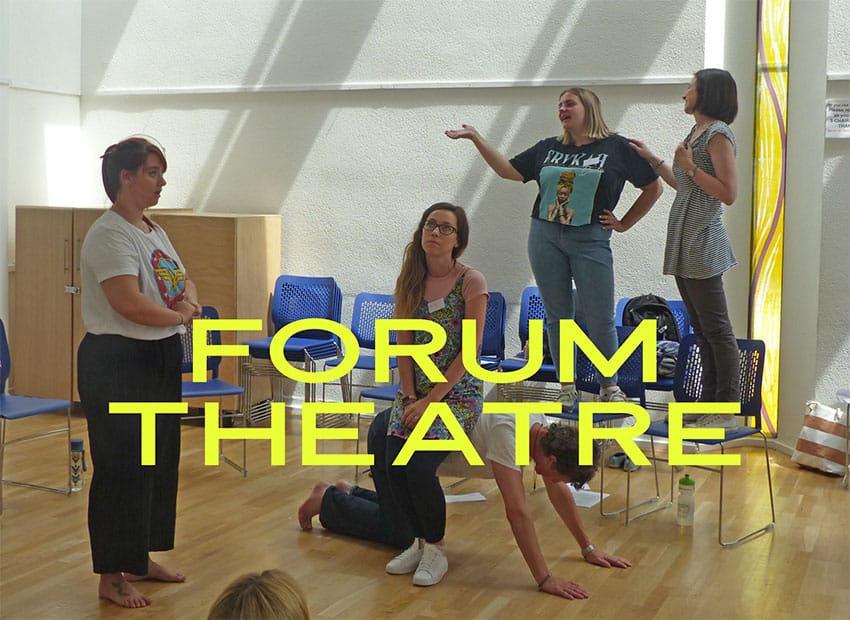
Members of the audience are given the opportunity to intervene and change the action in a performance.
A play or scene (usually showing a form of oppression) is performed twice. During the second run-through, any member of the audience (‘spect-actor’) is allowed to shout ‘Stop!’ when they think a different course of action would produce a more successful outcome.
The spect-actor is invited to step forward and take the place of one of the oppressed characters. The scene starts again from a chosen moment so that the spect-actor can try a new approach to change the situation for the better.
If this doesn't work, alternative courses of action can be tried out by members of the audience. The performers remain in character, improvising their responses to each intervention. A facilitator (Joker) is necessary to enable communication between the players and the audience.
The strategy breaks through the barrier between performers and audience, putting them on an equal footing. It enables participants to try out courses of action which could be applicable to their everyday lives. Forum Theatre was pioneered by Brazilian radical Augusto Boal as a political tool for change (part of Theatre of the Oppressed), but has been widely adapted for use in educational contexts.
Forum Theatre
Members of the audience are given the opportunity to intervene and change the action in a performance.
A play or scene (usually showing a form of oppression) is performed twice. During the second run-through, any member of the audience (‘spect-actor’) is allowed to shout ‘Stop!’ when they think a different course of action would produce a more successful outcome.
The spect-actor is invited to step forward and take the place of one of the oppressed characters. The scene starts again from a chosen moment so that the spect-actor can try a new approach to change the situation for the better.
If this doesn't work, alternative courses of action can be tried out by members of the audience. The performers remain in character, improvising their responses to each intervention. A facilitator (Joker) is necessary to enable communication between the players and the audience.
The strategy breaks through the barrier between performers and audience, putting them on an equal footing. It enables participants to try out courses of action which could be applicable to their everyday lives. Forum Theatre was pioneered by Brazilian radical Augusto Boal as a political tool for change (part of Theatre of the Oppressed), but has been widely adapted for use in educational contexts.
Introducing Augusto Boal

Three full-length practical sessions introducing the work of the Brazilian theatre maker who revolutionised theatre. The article introduces the concept of Image Theatre, Forum Theatre and Theatre of the Oppressed and includes activities such as The Great Game of Power, Status Pictures, Flashbacks, Complete the Image and Rainbow of Desire as well as a handy glossary. Suitable for 11 years and above. Written by David Farmer for Teaching Drama magazine.
Buy the 5-page Augusto Boal Drama Unit (PDF) for just £5.49 with credit/debit card, PayPal, Apple Pay or Google Pay.


10 Second Teaching Tips
3D Living Pictures

Action Clip
Conscience Alley

Cross-Cutting

Developing Freeze Frames

Drama For Writing
Flashbacks and Flash Forwards

Forum Theatre

Freeze Frames
Hot Seating

Hot Spotting
Image Theatre

Mantle of the Expert

Marking the Moment
Role on the Wall


Storytelling


Thought Tracking

Where Do You Stand?

Whoosh! Bringing Stories Alive through Drama
10 Second Teaching Tips
3D Living Pictures
Action Clip
Conscience Alley
Cross-Cutting
Developing Freeze Frames
Drama For Writing
Flashbacks and Flash Forwards
Forum Theatre
Freeze Frames
Hot Seating
Hot Spotting
Image Theatre
Mantle of the Expert
Marking the Moment
Role on the Wall
Storytelling
Thought Tracking
Where Do You Stand?
