
Flashbacks and Flash Forwards
Go backwards and forwards in time starting with a single Freeze Frame.
Performers in a scene are asked to improvise scenes which take place seconds, minutes, days or years before or after a dramatic moment. This enables the exploration of characters’ backgrounds, motivations and the consequences of their actions.
The method can be used to quickly bring depth to activities involving freeze frames or improvised drama. Adding Flashbacks or Flash Forwards creates a context – it shows what led up to a particular moment, how it might be resolved or how it may lead onto additional challenges. The technique helps to flesh out a dramatic moment or create the beginnings of a story.
How to do it
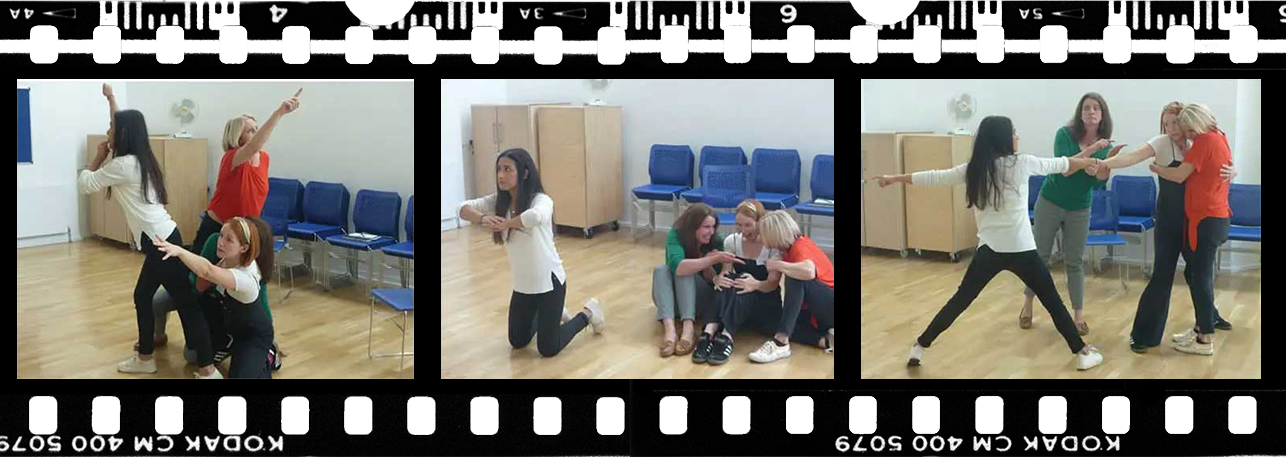
With a group that has created a freeze-frame, explain that when you clap your hands, you would like them to move silently in slow-motion to where their character was a few moments before. When they are frozen still in the new image, you can use thought-tracking to explore character motivation.
Now ask them to move back to their original image – which is the present moment. Then you can use Flash Forwards – participants move in slow-motion to indicate where their characters might be a short time after this moment. In this way you have created an episode with a beginning, middle and end and can develop it in any number of ways.
Flashbacks & Flash Forwards
Go backwards and forwards in time starting with a single Freeze Frame.
Performers in a scene are asked to improvise scenes which take place seconds, minutes, days or years before or after a dramatic moment. This enables the exploration of characters’ backgrounds, motivations and the consequences of their actions.
The method can be used to quickly bring depth to activities involving freeze frames or improvised drama. Adding Flashbacks or Flash Forwards creates a context – it shows what led up to a particular moment, how it might be resolved or how it may lead onto additional challenges. The technique helps to flesh out a dramatic moment or create the beginnings of a story.
How to do it
With a group that has created a freeze-frame, explain that when you clap your hands, you would like them to move silently in slow-motion to where their character was a few moments before. When they are frozen still in the new image, you can use thought-tracking to explore character motivation.
Now ask them to move back to their original image – which is the present moment. Then you can use Flash Forwards – participants move in slow-motion to indicate where their characters might be a short time after this moment. In this way you have created an episode with a beginning, middle and end and can develop it in any number of ways.
50 Amazing Ways to Use Freeze-Frames!

Practical information and ideas about using Freeze-Frames and Still Images in Drama and other lessons, including Benefits, When/How to use them, combining with Drama Strategies, 50+ Ways to use them across the Curriculum and a handy Photocopiable Evaluation Checklist!
Buy the 7-page Freeze-Frames and Still Images Drama Unit (PDF) for just £5.49 with credit/debit card, PayPal, Apple Pay or Google Pay.

3D Living Pictures

Action Clip
Conscience Alley
Cross-Cutting
Developing Freeze Frames

Drama For Writing
Flashbacks and Flash Forwards
Forum Theatre
Freeze Frames
Hot Seating
Hot Spotting
Image Theatre
Mantle of the Expert
Marking the Moment

Role on the Wall
Storytelling
Teacher in Role

Thought Tracking
Where Do You Stand?
Whoosh! Bringing Stories Alive through Drama
3D Living Pictures
Action Clip
Conscience Alley
Cross-Cutting
Developing Freeze Frames
Drama For Writing
Flashbacks and Flash Forwards
Forum Theatre
Freeze Frames
Hot Seating
Hot Spotting
Image Theatre
Mantle of the Expert
Marking the Moment
Role on the Wall
Storytelling
Teacher in Role
Thought Tracking
Where Do You Stand?
